Optimizing design to Reduce new Vendor drop off rate by 25% and existing Vendor drop off rate by 54% within onboarding
About:
This article covers a design optimization project focused on reducing vendor drop off during VMS onboarding. The goal was to make compliance feel obvious, low effort, and trustworthy by removing ambiguity from the workflow and clarifying what vendors needed to do, what they had already done, and who they were becoming compliant for.
The problem: unclear and complex requirements
Vendors were abandoning the compliance flow for reasons that were not about motivation, but about clarity.
The current workflow did not make it obvious what was complete and what still needed to be completed. During onboarding, vendors were unsure which PMC they were becoming compliant for, which reduced trust and increased hesitation.
Uploading documents required multiple steps, creating unnecessary friction and more chances to fail. Statuses were unclear, so vendors would upload a document and assume they were finished. It was not obvious that a final submit step was required to complete the process.
The principles: simplify and clarify
Make it extremely clear what is required to complete compliance.
Make it extremely clear which PMC the vendor is becoming compliant for, using social proof and context to build trust.
Reduce effort by turning document upload into a single step, one click flow.
Improve status clarity so vendors always know what stage they are in and what happens next.
The insight: completion through clarity
Most onboarding drop off is not caused by unwillingness, rather, it is caused by uncertainty and lack of clarity. If a vendor is unsure what the platform expects, unsure who the compliance is for, or unsure whether their action actually completed the workflow, they pause and often never return. The best conversion lever is not persuasion, it is certainty.
The solution: focus on design to drive clarity
We redesigned the VMS onboarding compliance experience around three core improvements: progress clarity, buyer context, and reduced effort.
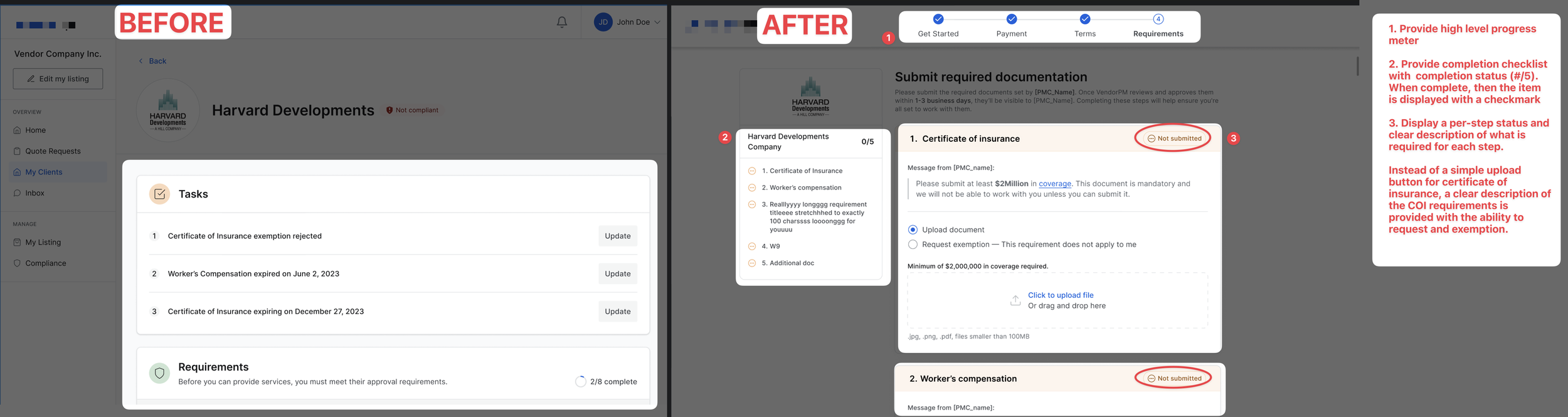
Make progress visible and self explanatory
We introduced a clear checklist style structure that explicitly separates what is completed versus what still needs action. Each requirement has a visible state and a single call to action so the vendor never has to guess what the next step is.
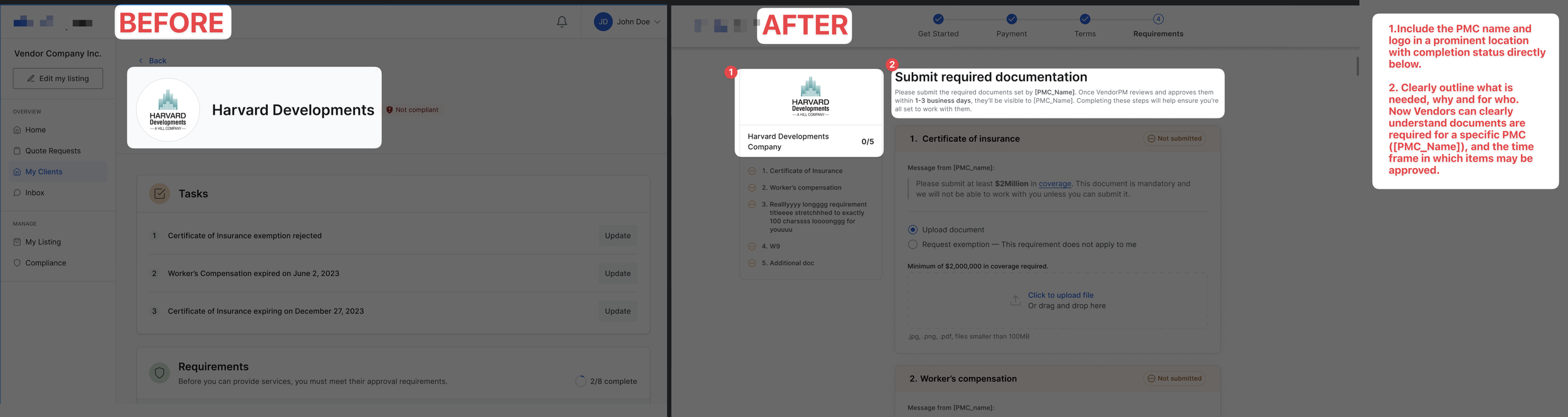
Clarify which PMC the vendor is becoming compliant for
We made the PMC context unavoidable in the UI. Vendors can immediately see the PMC name and supporting context that reinforces legitimacy and builds trust. This acts as social proof and reduces the anxiety of uploading sensitive documents without knowing who they are for.

Reduce document upload to one step
We simplified the multi step upload experience into a one click upload motion. The goal was to remove unnecessary interaction cost and eliminate the chance that vendors drop off between steps or fail to complete the upload.
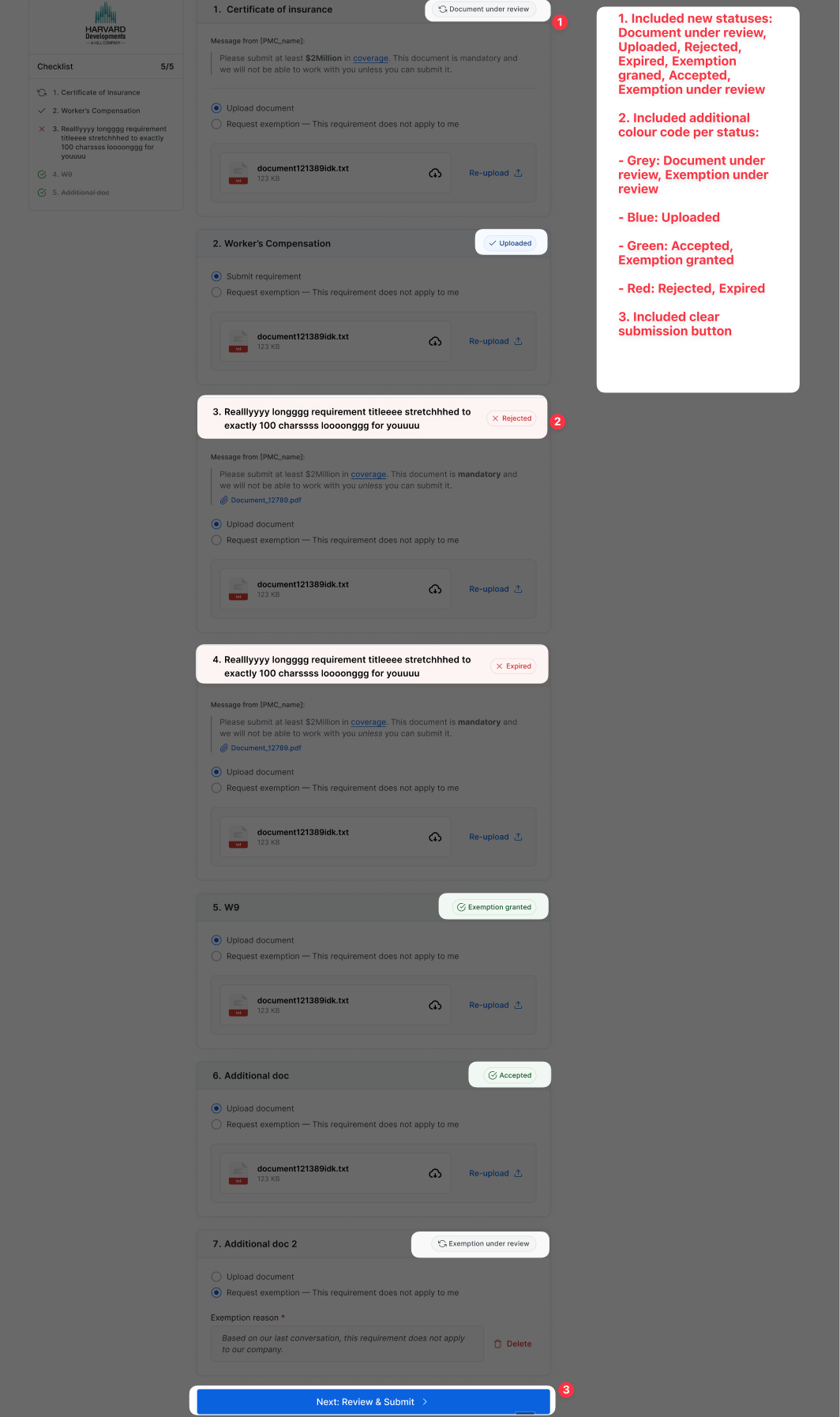
Improve statuses so completion is unmistakable
We updated status language and visual indicators so vendors understand exactly what happens after upload. We also clarified the difference between uploading a document and submitting the compliance package, making the final submit step explicit and impossible to miss.
The outcome: reduced workflow abandonment
Drop off rates within the workflow reduced by 25% for new vendors and 54% for existing vendors within this workflow. This redesign reduced vendor drop off by removing ambiguity at each point of friction. Vendors could clearly see what was required, who the compliance was for, and whether they had actually completed the workflow. By compressing uploads into a single action and making statuses and submission explicit, the onboarding experience became faster, clearer, and easier to finish.
